Here are 12 of the most common reasons your home isn’t selling and actions you can take to get your sale back on track.
1. The price is too high
Homebuyers pay attention to overpricing. In a HomeLight survey of more than 1,000 top real estate agents across the country, overpriced homes ranked as the number one deal-breaker for buyers.
“If it’s not condition, it’s always price,” says Simpkins. “And in fact, it’s usually always price.”
How do you know if your home is priced too high? Pricing a home for sale is deceivingly complex. To predict what buyers would pay, you must carefully review recent sales and make dollar adjustments to your property based on competitive differences.
Our Home Value Estimator can be a helpful tool for this task. Enter your address and answer a few basic questions about your home, and we’ll provide a preliminary home valuation in less than two minutes.
However, an online estimate is just the starting point. If you priced the home yourself, get a real estate agent’s opinion on if you were too ambitious.
“Eighty percent of what we do is strategic pricing; 20% is presentation for marketing,” says Regina Madiera-Gorden, a top real estate agent in Tacoma, Washington. “As agents, we have access to more on-demand information that paints a picture of where we should shoot for price.”
Additionally, pay attention to the feedback you get from people at open houses and showings. Were they disappointed at the home’s quality compared to the price?
You can also browse local listings. If your home is priced higher than nearby houses with better features and more upgrades, it’s a telltale signal that price is the issue.
What’s the fix?
In most cases, it’s time for a price drop.
A price cut may sound like the kiss of death for getting the value you’d hoped for. But in reality, price reductions are quite common and sometimes necessary to reel buyers in.
According to data from the National Association of Realtors (NAR), 36% of buyers considered a better price when purchasing a previously owned home.
So, how much should you lower the price?
“You don’t want to be the house that drops the price a thousand dollars every week,” says Simpkins. “I’d say a significant price reduction will get the job done.”
If a listing is getting a lot of showings but no offers, Madiera-Gorden suggests a 1% markdown might entice the right buyers. If there are few showings, a 2% to 3% price reduction may be necessary.
It’s also important to be mindful of online price filters. “Buyers search in $25,000 to $50,000 increments generally,” Madiera-Gorden explains. “So, we try to be cognizant of stepping into the next price bracket — if necessary — to get the property in front of the right buyers.”
2. You missed the market’s peak
Real estate isn’t as volatile as the stock market, but it can quietly shift while you aren’t paying attention.
According to Realtor.com research, the number of homes with price reductions has been rising. The percentage of homes with price reductions increased from 15.5% in July of last year to 18.9% in July 2024.
“Homes priced right are selling quickly,” shares Christine Radford, a top real estate agent in Jacksonville, Georgia, a market Radford describes as 60% retirees and pre-retirees.
“Homes overpriced and/or not in top condition are sitting longer. We have lots of picky buyers waiting for the right property who are in no rush to buy.”
Recently, Madiera-Gorden worked with sellers who knew of a house down the street with a similar floorplan that sold in two days for $20,000 above the asking price.
Since her client’s house had significant upgrades compared to the neighbors’, they planned to set an even higher list price than what the comp sold for.
However, in a mere four months since the neighbor’s sale, “The velocity of the market had really slowed, so we had to adjust our price,” Madiera-Gorden says.
What’s the fix?
Keep up with what’s happening in the market and examine buyers’ options in real time. Madiera-Gorden and her daughter and business partner, Madison Lord, sometimes take their sellers on an in-person or virtual home tour of similar properties.
Taking that journey with a professional allows sellers to arrive at a better understanding of how their home stacks up against others and how they can improve its appeal to buyers.
Depending on what the competition looks like, a seller may either choose to bring their house up to standard or reduce the price accordingly. For example, if every other comparable listing has a furnace that’s less than five years old and yours is upward of 12, maybe it’s time to install a new one.
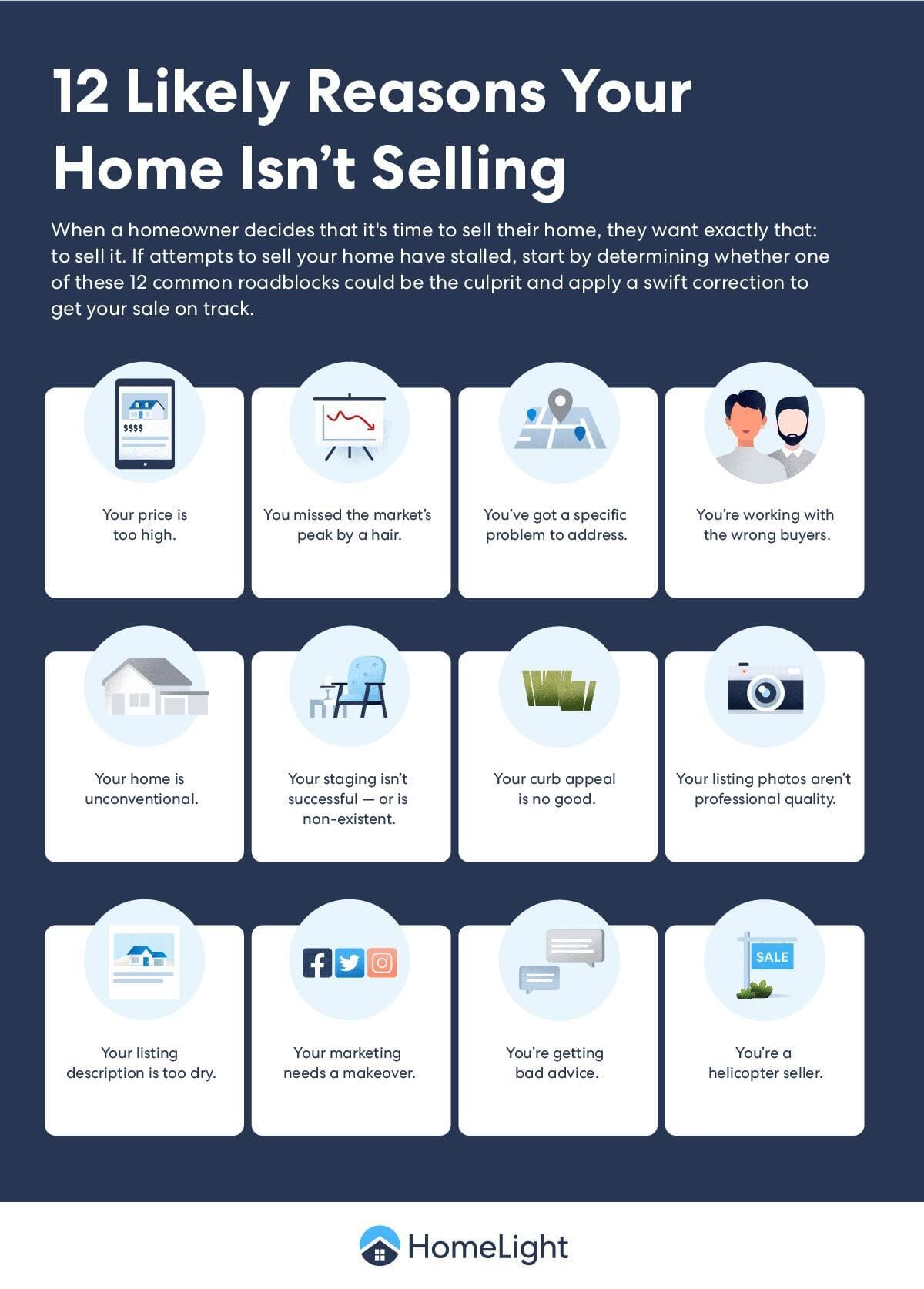
3. You’ve got a specific problem to address
Even if a showing doesn’t provide you with a buyer, it gives you something important: intel. “Showing feedback is extremely important,” says Simpkins.
According to Simpkins, the questions your agent should be collecting from a showing are, “What’s wrong with this home? What would need to change to make you want to buy this home?”
If you get the same answer from multiple people, you know you have a problem.
What’s the fix?
Once you’ve identified that there’s an issue, you can work to mitigate it. If multiple buyers say your house is too dark, you can add lighting, declutter, or hire someone to clean the windows.
If buyers are having trouble envisioning something specific — where to hang a TV in a living room full of windows, or how to fit a king-sized bed in a smaller master bedroom — you can update your staging to illustrate a solution.
You also may need to address a significant cosmetic flaw or expensive repair. For example, in evaluating one of her listings, Lord noticed a massive splotch on a kitchen counter. She knew buyers would be deterred by having to replace it.
“Our preferred contractors put a new slab of quartz for $2,000,” she says. “Those types of fixes bring you value on the market.”
Of course, some things can’t be changed. What if your homeowners’ association dues are high, or your street is clogged with cars going to the stadium every game day?
“Price cures all,” says Simpkins.