

 By admin1
Conduct your own “CMA Lite”
It’s time to roll up your sleeves and research.
Start with an online home value estimate
As a starting point, look at several online estimators for your home’s value. HomeLight’s Home Value Estimator aggregates publicly available data such as tax records and assessments, your home’s last sale price, and recent sales records for other properties in the same neighborhood.
We also add a new layer of information to our estimates using a short questionnaire. Tell us a few details about your Michigan home, such as:
- How much work does it need?
- What type of home is it (single-family, condo, townhouse, or other)?
- Roughly when was your house built?
- Are you planning to sell soon?
Using these insights, we’ll provide you with a preliminary estimate of home value in under two minutes.
Whether you use Zillow, Chase, Realtor, or Redfin to get a home value estimate, think of any online home price tool as a first step (not your only source of truth) — and recognize that the data used may be limited.
Narrowly filter your search for comps
When you’re ready to find comps, you can choose from sites like Zillow, Trulia, Redfin, or Realtor.
You’ll want to filter your searches to the area very near your house (within blocks if possible) and with similar characteristics. If you’re not finding any comps, expand your search map.
You’ll also want to filter results by details like:
- Listing status (look at recently sold, pending, and active)
- Number of bedrooms
- Number of bathrooms
- Square footage
- Home type (single-family, condo, etc.)
Beyond the above criteria, the more houses you find with floor plans and an age similar to yours, the better.
Use a site like Zillow to collect your data
As an example, let’s take a look at how to filter your search for comps on Zillow.
- Navigate to Zillow.
- Type in your address. If a pop-up with your home’s specs appears, close it with the “X” on the top right (or sometimes you must click “Back to search” on the top left).
- Filter by “sold.” Yellow dots should appear on the map surrounding your house, and you will see all the recently sold homes on the right.
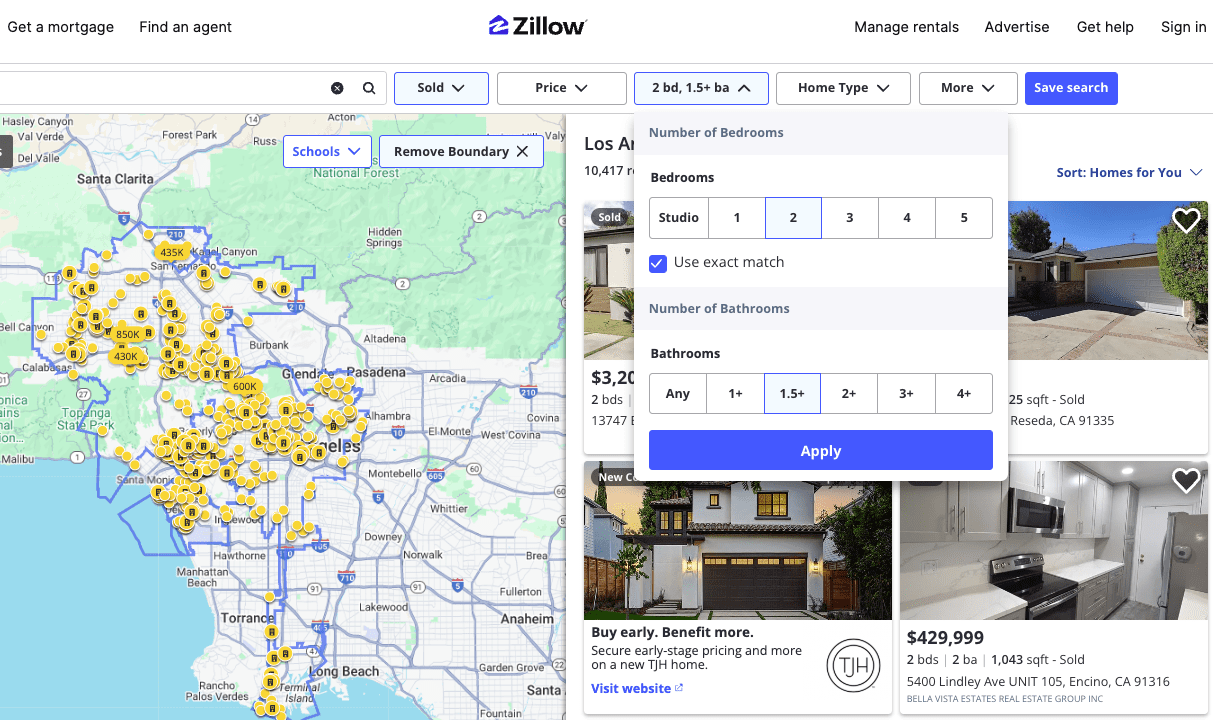
- Now, filter by the number of bedrooms and bathrooms and check the box “Use exact match.”
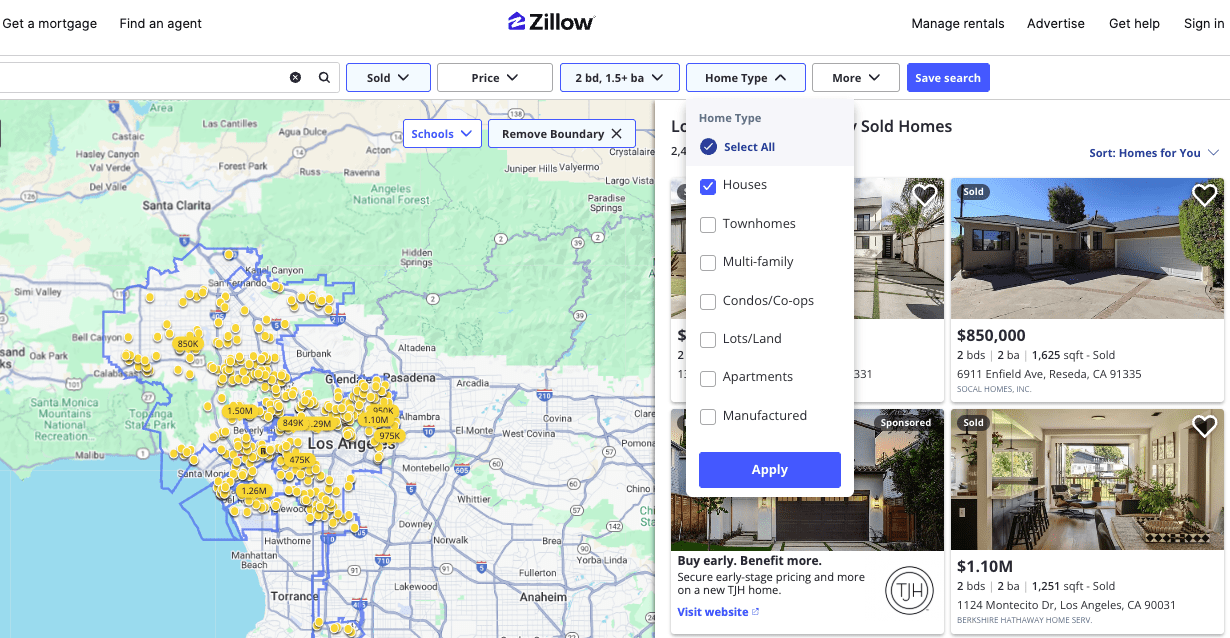
- Next, filter by home type.
- Next, select the “More” box. Here, you can specify square footage, lot size, and year built.
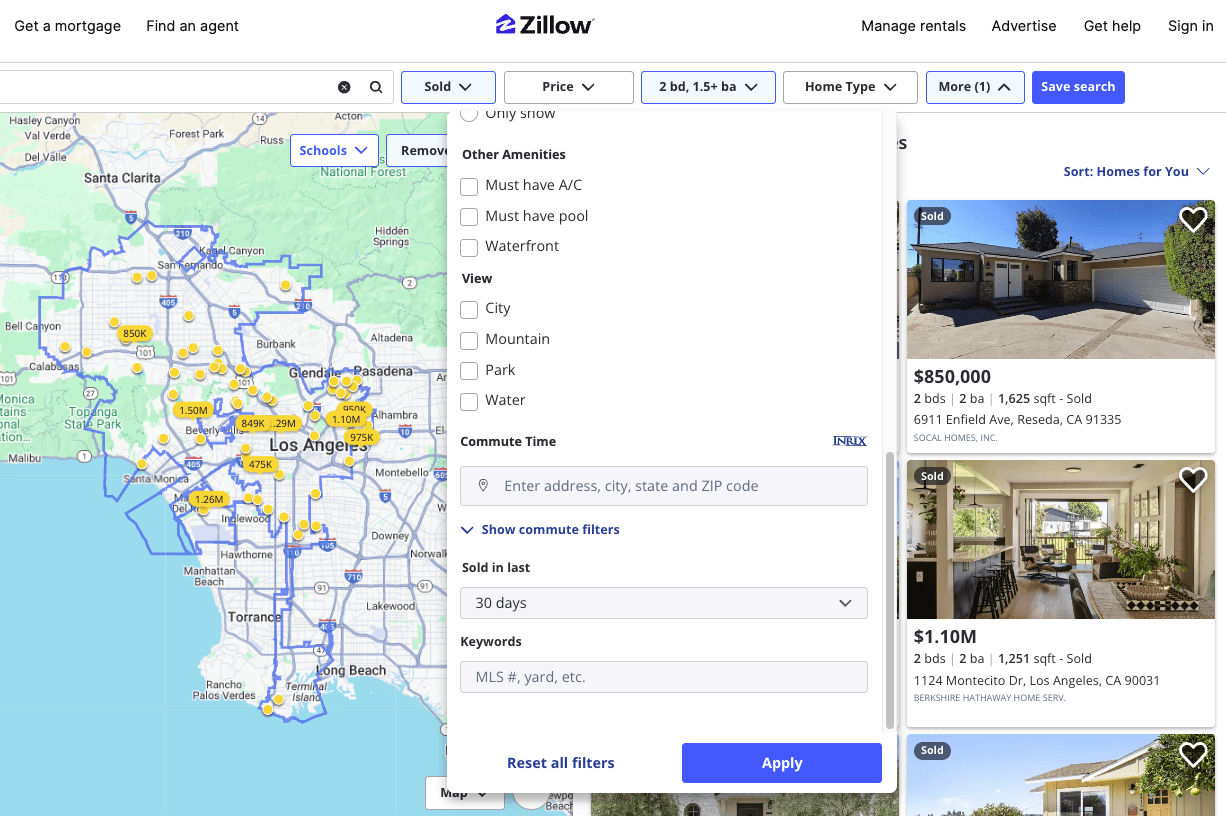
- While still in the “More” filter box, scroll down and select to view houses that sold in the last 30 days. If you find there are not many results in your area, try expanding to 90 days. However, the further back you go, the less relevant the comps.
- If necessary, click the plus or minus buttons to widen the search area.
- Once you’ve collected data for sold houses, revise or restart the search to view active and pending listings, as well.
“Don’t rely on an online estimate to set your price. Zillow provides a blanket estimate that doesn’t consider key items that determine the value of a home: number of bedrooms, bathrooms, age of home, construction, and so on. In order to get a true valuation, you need to think like an appraiser,” warns Rodriguez.
Invest in a professional home appraisal
If you want to further reduce guesswork, top agents recommend paying an appraiser to provide a professional opinion of value for your home. An appraiser will combine recent property data, research of the surrounding market, and information collected from a walkthrough of your home to determine an appraised value. For a single-family home, an appraisal will likely cost $350 to $500 — well worth it to avoid possibly over- or underpricing your house by thousands.
Make sense of the research
Compare your home’s features against the nearby comps you collected. Hopefully, the houses you studied give an indication of an appropriate price range for your home. From there, you can make dollar adjustments based on characteristics that add value (patios, curb appeal, an extra bedroom) versus those that detract from it (a busy street, deferred maintenance, less square footage).
Consider the differences and similarities of comps with the appraised value of your home to choose a price that will encourage activity (too high and it may seem out of reach to many buyers) but will also maximize your profit.
3. Photograph your home
Listing photos are powerful, either pulling in buyers for showings or keeping them away.
To give your listing an edge, consider hiring an experienced real estate photographer. While they may charge as much as $123 to $272 an hour, this could be one of the most important things you do to sell your home.
Sheerin says you can often tell a FSBO home listing by its poor-quality photos. The images might be dark, blurry, or focus on the wrong things. “When homeowners don’t hire a professional photographer, they just don’t do the home justice,” he cautions.
But if you do go the DIY route, make sure to:
- Use a good camera with a wide-angle lens.
- Pay attention to lighting.
- Include a photo of every room.
- Take multiple pictures of living areas, kitchens, and bathrooms.
- Try shooting different angles.
Review our guide on how to take quality real estate photos for further guidance.
4. Create a detailed, compelling listing
Along with stellar photos, you’ll want to craft an informative and compelling listing. Leverage both the listing description (a paragraph or two highlighting key features) and the property details to show potential buyers all about your home and what makes it desirable.
Tell a story with your description
Draw in potential buyers with a powerful listing description that tells a story about your Michigan house, including details like:
- Your home’s most unique and desirable features, like a breakfast nook or sunroom
- Recent upgrades like a kitchen or bathroom remodel, or a new roof or HVAC system
- High-end appliances, materials, or finishes
- Outdoor features like a pool or patio
- Neighborhood features and amenities
- Nearby parks, walking trails, beaches, restaurants, and attractions
Don’t skimp on the property details
Aside from writing the description, you may be prompted to enter information like:
- Age of the home
- Square footage
- Architectural style (i.e., split-level, rancher, craftsman)
- Appliances included
- Exterior building materials
- Flooring types
- HOA fees
- School zone information
- Lot size
Many real estate agents and potential buyers really do read this “fine print” on your listing — so include accurate details, and plenty of them.
5. List your home online
It’s finally time to post your Michigan home online. While you can create FSBO listings for free on popular search sites, you’d have to painstakingly post site by site, and your listing wouldn’t reach the majority of buyers and agents.
To give your home the most exposure, pay to have your home put on your local MLS (multiple listing service) — a platform agents use to share properties with one another as well as major real estate sites. Posting there will feed your listing to buyers’ agent databases and to common sites buyers use.
Only licensed real estate agents and brokers who are MLS members can post to the MLS. However, you have two options to gain access: paying an agent to post for you or using a FSBO platform online.
Pay an agent to list your home on the MLS
A local agent may be willing to list your house on the MLS for a flat fee, without any other involvement in your real estate transaction. If you decide to go this route, make sure you ask whether the fee includes updating your listing if necessary.
Use a FSBO platform with an MLS option
There are a variety of paid websites that you can use to list your Michigan house online as “for sale by owner.” These sites offer packages ranging from about $100 to $400 for just a listing, or a larger flat fee of $3,000 to $5,000 that includes any number of additional professional marketing services.
Some of these companies display their rates on their websites, but others won’t quote a fee until you input your address or select an area of the country. A few examples include:
It’s important to note that most of these companies serve FSBO sellers nationwide, which can cause challenges if the assisting representatives don’t understand the local market trends in your Michigan neighborhood.
Whatever you choose, read the fine print carefully: some sites may have hidden fees or even take a percentage off your sale – a detour you’d rather avoid on the FSBO route.
Not willing to pay for the MLS?
If you’re determined to save money by forgoing the MLS, creating a free FSBO listing on Zillow might be your top option. You can post videos and unlimited photos, and get fairly wide exposure via Zillow and the Zillow-owned Trulia.